ViTacPhys

Physical Property-Aware Grasping from Human Visual-Tactile Demonstrations

Under review

Overview video. ViTacPhys infers object mass, stiffness, and friction from visual-tactile interaction and uses them to condition a dexterous-hand grasping policy.

Abstract

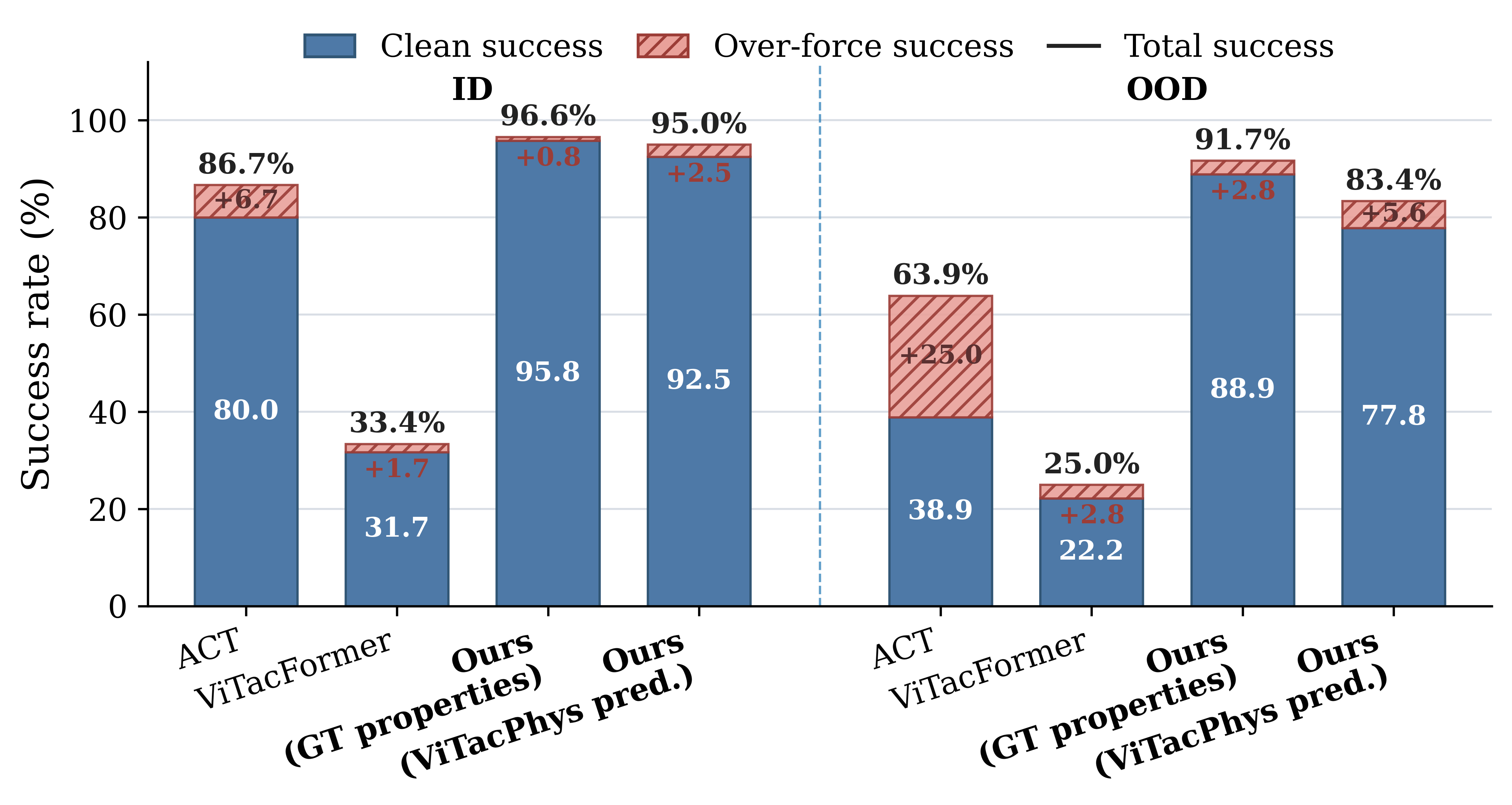
Recent vision-based action models rarely account explicitly for the physical properties needed to adapt a manipulation policy. We introduce ViTacPhys, together with a visual-tactile data acquisition and labeling system, to predict object mass, stiffness, and friction coefficient from human manipulation demonstrations. Trained on 60 rigid and deformable objects with 1,800 demonstrations, ViTacPhys combines temporal visual-tactile modeling, cross-attention multimodal fusion, and semantic priors distilled from a vision-language model. It reaches over 97% mass and friction accuracy with below 6% stiffness relative error on seen objects, and achieves 87.5% mass accuracy, 97.5% friction accuracy, and below 10% stiffness error on unseen objects from known categories. We transfer ViTacPhys to a dexterous robot with limited teleoperation data, video-generated augmentation, and matched-action human demonstrations, then use its predictions online to condition an adaptive grasping policy. The resulting policy achieves over over 95% total grasping success on ID objects and 83% on visually similar OOD objects with different physical properties, while producing forces more consistent with human teleoperation.

Vision-tactile fusion Physical property prediction Adaptive grasping

Method

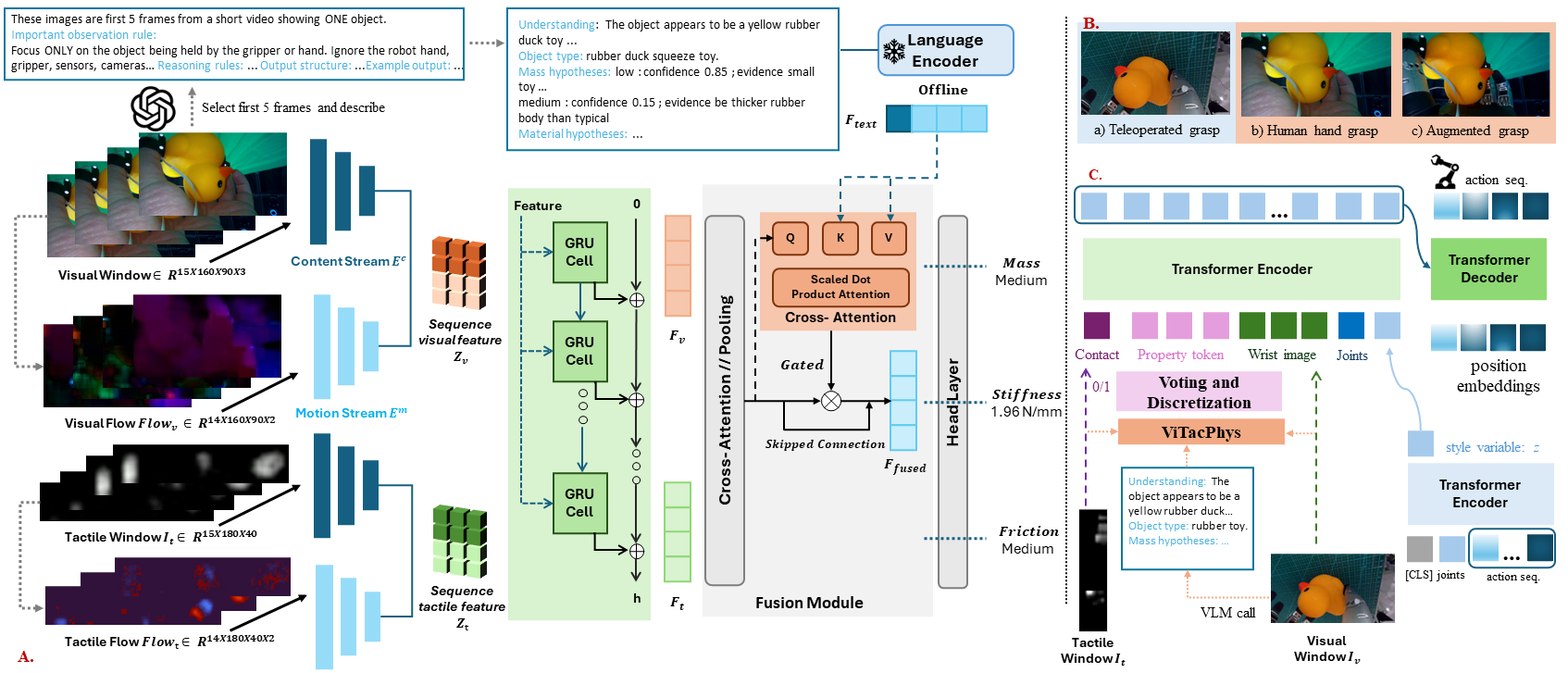
ViTacPhys predicts physical properties from temporal visual-tactile observations and deploys them online as structured inputs to an adaptive ACT-style grasping policy.

ViTacPhys method and human-to-robot transfer pipeline
Rendering figure…

ViTacPhys pipeline. Temporal visual-tactile observations and flow features are fused with offline VLM-distilled semantic priors to predict mass, stiffness, and friction. Human-to-robot transfer uses teleoperation data, matched-action human demonstrations, and visually augmented human demonstrations.

ViTacPhys Dataset

The dataset contains 1,800 one-second human grasping demonstrations at 30 Hz, collected from 60 representative rigid and deformable objects using vertical-lift and lateral-shaking protocols.

Wearable Data Collection System

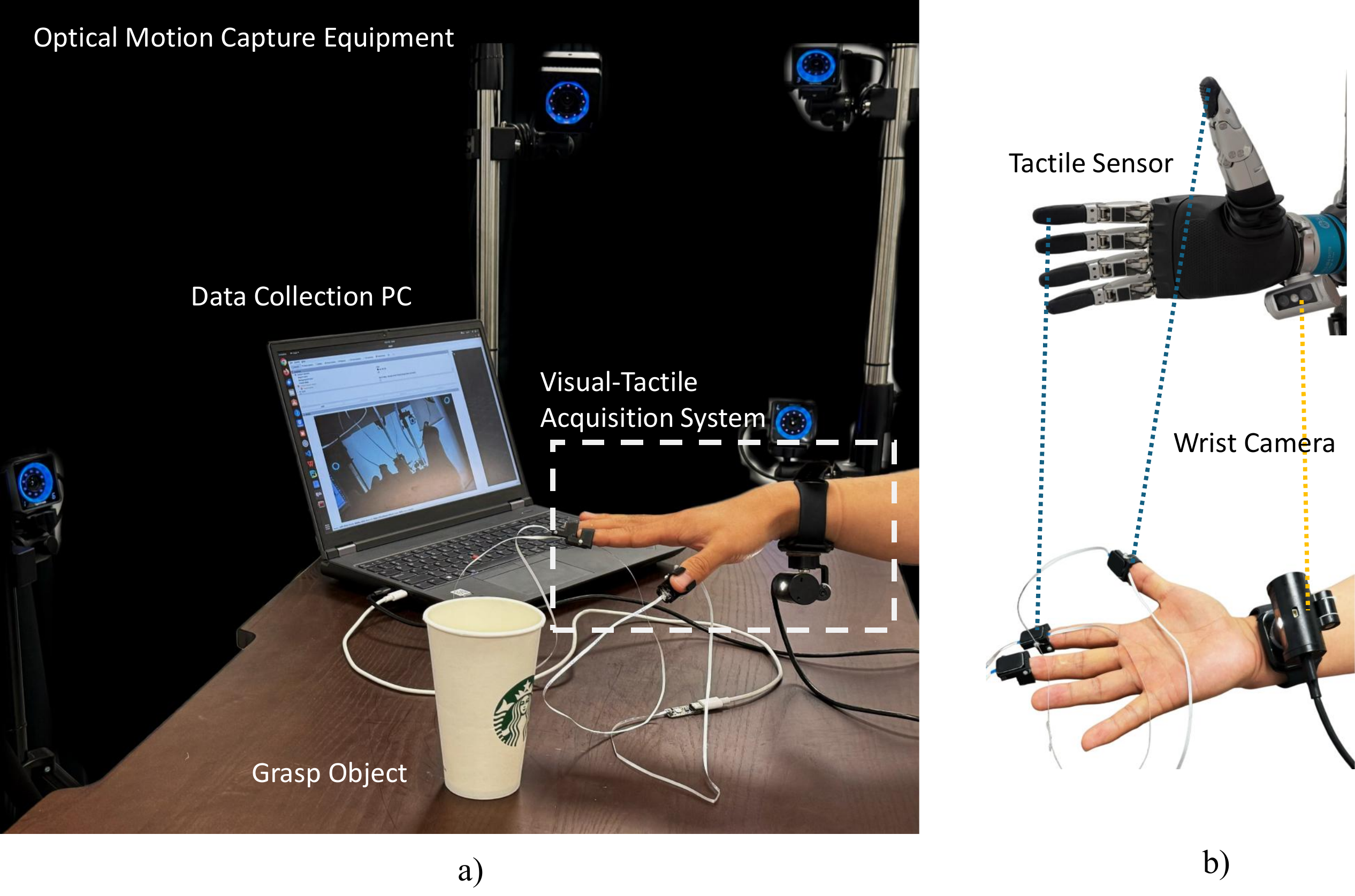
Wearable visual-tactile data collection system
Rendering figure…

Acquisition setup. Wrist RGB, fingertip tactile maps, and motion-capture markers are aligned to match the real robot's sensing layout. Mass, stiffness, and friction are then labeled with a precision scale, force–displacement fitting, and an inclined-plane test.

Dataset Objects

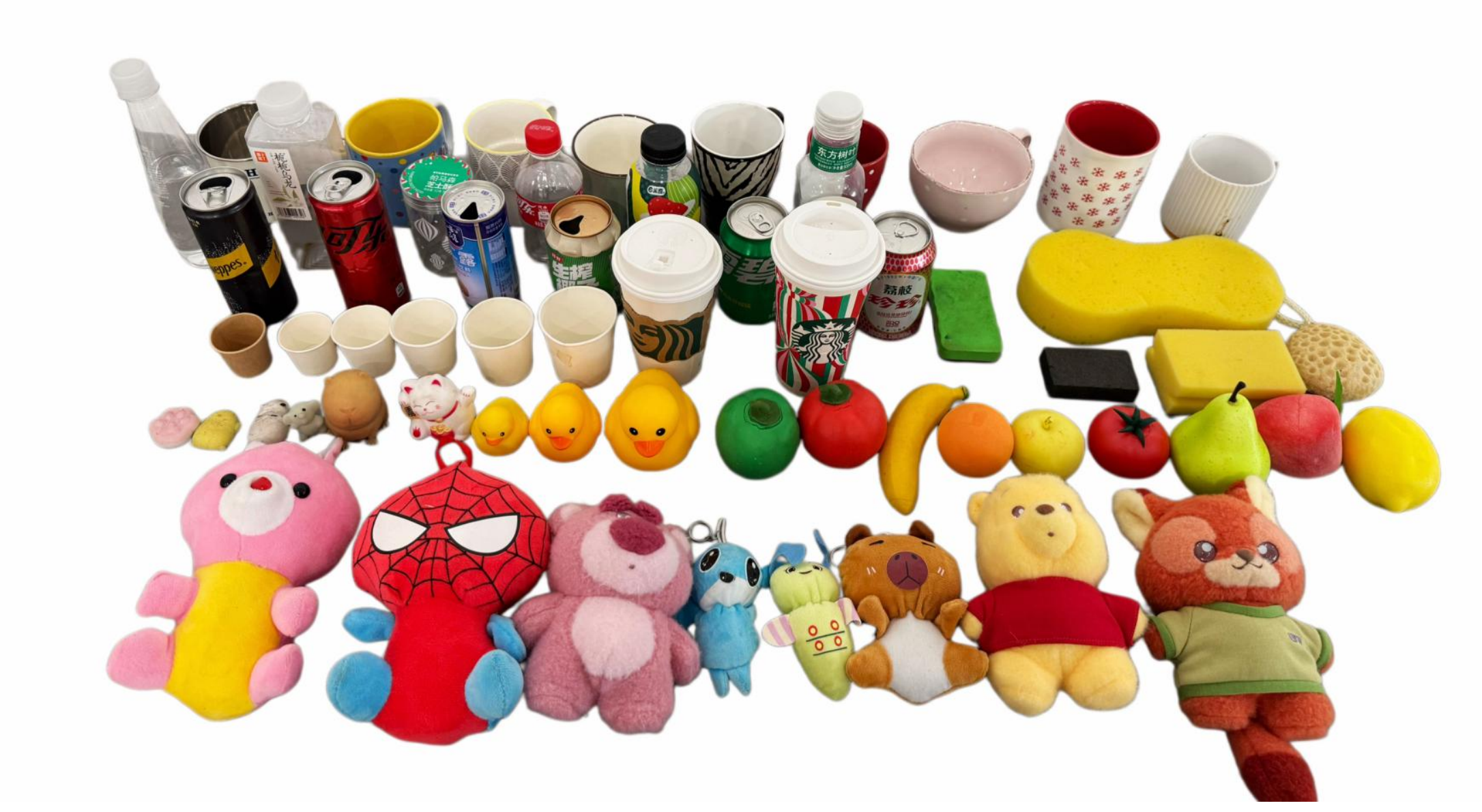
Objects in the ViTacPhys dataset
Rendering figure…

Everyday objects. The collection spans containers, toys, fruits, sponges, and soft objects with diverse mass, stiffness, and surface friction.

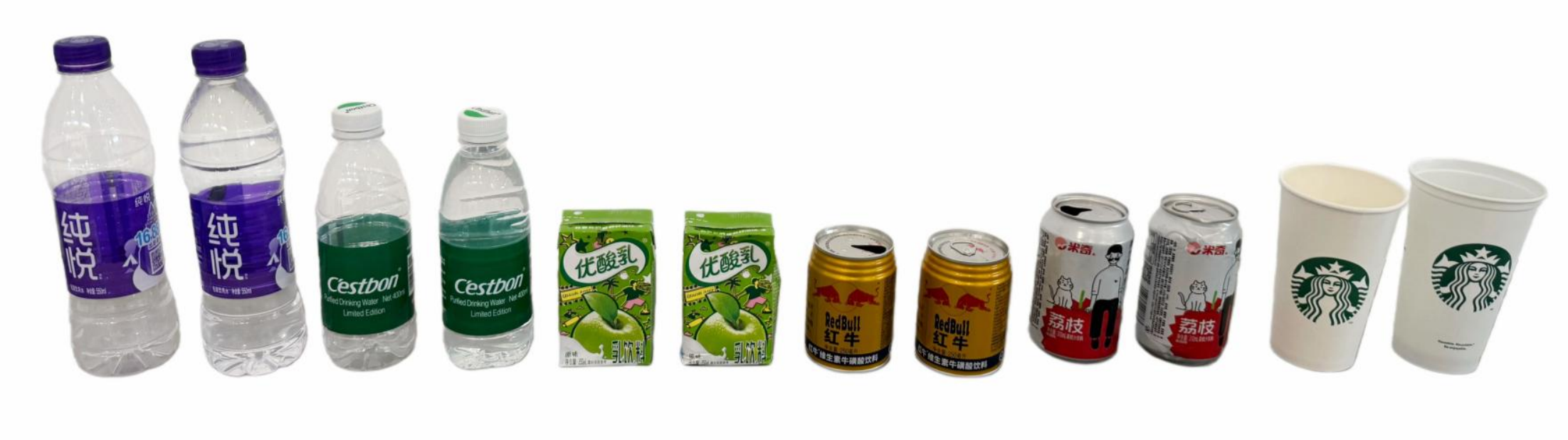
Downstream task object data
Rendering figure…

Downstream Task Data.

Each object has 15 trials for each protocol with varied approach directions and hand postures. The dataset uses wrist-mounted RGB and tactile sensors corresponding to the real robot sensing layout.

Experimental Results

Physical-property prediction

ViTacPhys is evaluated on new interactions with seen objects, held-out objects from known categories, and a one-shot setting with highly limited training-object diversity.

Setting Mass Stiffness Friction
Acc.↑Macro-F1↑ MAE↓MAPE↓Pearson↑ Acc.↑Macro-F1↑
In distribution 0.9720.970 0.2485.510.980 0.9880.984
Held-out object 0.8750.866 0.4359.080.947 0.9750.971
One-shot (avg.) 0.4920.480 0.83716.840.680 0.5690.527

Stiffness in N/mm; MAPE in %. Best in-distribution scores highlighted. (Paper Table II.)

Human-to-Robot Transfer

We initialize ViTacPhys from the human in-distribution model and fine-tune it with robot teleoperation data (Tele.), visually augmented dexterous-hand demonstrations (Aug.), and matched-action human demonstrations (H). The strongest OOD transfer uses all three data sources.

SplitInitializationTraining data Mass Stiffness Friction
Acc.↑Macro-F1↑ MAE↓MAPE↓ Acc.↑Macro-F1↑
IDScratchTele.0.9980.9960.2175.101.0001.000
Tele.+Aug.+H0.9600.9660.3156.780.9650.973
Fine-tunedTele.0.9070.9120.2014.660.9490.960
Tele.+H0.9260.9270.1643.660.9860.989
Tele.+Aug.0.9220.9080.1713.970.9500.962
Tele.+Aug.+H0.9100.9170.2034.340.9620.971
OODScratchTele.0.4450.3401.26835.900.5870.443
Tele.+Aug.+H0.4120.4541.59642.450.6870.639
Fine-tunedTele.0.5440.5110.78120.290.7560.722
Tele.+H0.6090.6560.85021.070.6540.647
Tele.+Aug.0.6390.6600.83721.540.6930.650
Tele.+Aug.+H0.7800.7520.76619.010.8270.822

Stiffness MAE is in N/mm and MAPE is in %. Tele. = robot teleoperation, Aug. = augmented dexterous-hand demonstrations, H = matched-action human demonstrations. (Paper Table VII.)

Real-robot grasping success

Conditioning the policy on ViTacPhys predictions improves clean and total success, particularly on visually similar OOD objects with different physical properties, while reducing excessive-force grasps.

Real-robot adaptive grasping success rates on ID and OOD objects

Adaptive grasping success. GT Properties uses ground-truth physical properties; ViTacPhys Pred. uses properties predicted online by ViTacPhys.

(Paper Table III.) Over-force success = soft object lifted but visibly crushed — lower is better.

Real-Robot Grasping

ViTacPhys grasping a range of objects with property-dependent forces.

Comparison with Baselines

Side-by-side real-robot rollouts. Each clip shows, from left to right, ACT, ViTacFormer, and Ours on the same object.

Per-Object Comparison

Select an object below to compare all three methods on it side by side: ACT, ViTacFormer, and Ours.

Object 1

Failure Cases

Representative failures, e.g. mis-estimated properties on hard or extreme objects.

Experimental Platform

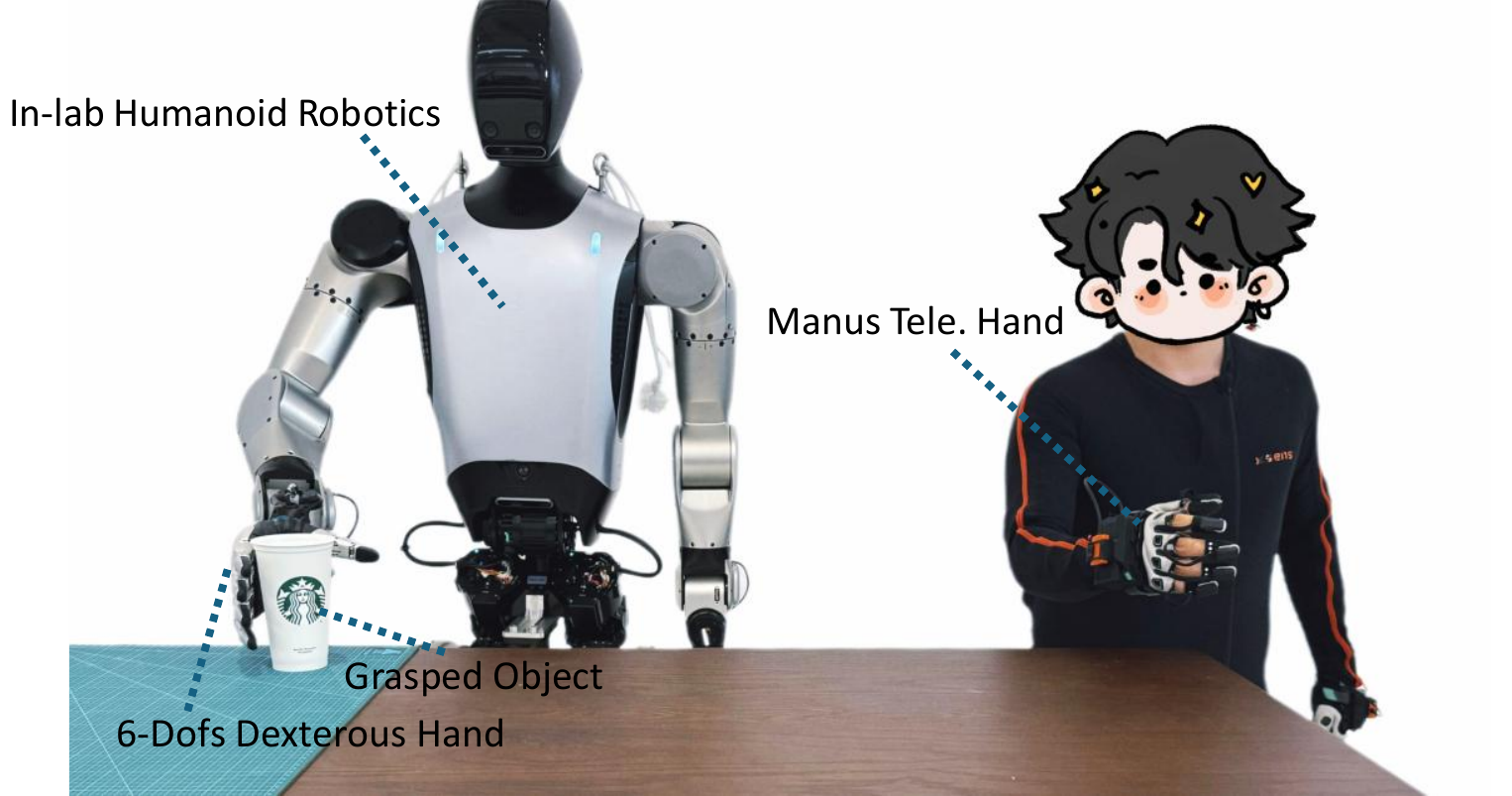
Dexterous robot teleoperation platform
Rendering figure…

A 7-DoF manipulator with a direct-drive 6-DoF dexterous hand; fingertips carry piezoresistive tactile arrays matching the human glove. Demonstrations are collected by teleoperation with a Quantum Manus glove — 10 demos for each of 50 objects.

BibTeX

@article{vitacphys2026,
  title   = {ViTacPhys: Physical Property-Aware Grasping from Human Visual-Tactile Demonstrations},
  author  = {Anonymous Authors},
  journal = {Under review},
  year    = {2026}
}